This is a continuation of policy relating to the glorious Imagine Nation of the Peoples Republic of Poetry. It is about the use of text aka txt. Nuspeek. Of course, there is the reference to Orwell’s 1984, written in the late 1940s reflecting the tek of the day. So how did it come to this: nuspeek?
1971-72 I attended Loyalist College of Applied Arts and Technology for the Communications Arts courses, video production, radio, photography, journalism. I was editor of the College newspaper. For a reason that escapes me, I also signed up for data processing, which was outside the Communications Arts course, but was part of the Business Courses.
My data processing teacher was Charles Kinghorn, and get a load of this, we have kept in touch with each other for the past 50+ years. On my first class, he did the usual, asked each student who they were and why they chose data processing. The entire class was composed of business students and then there was me, Poetician1.
This course taught me how to code back in the days of mainframe exclusivity, COBOL/FORTRAN. The course brought me up close to those heavily air conditioned rooms that housed the glorious mainframe. The smell of electricity filled the room, the smell of energy, the scent of machine calculation, and a constant low level ummmmmmm, all for a burst of binary blasts of ordered info.
I had no interest in becoming a coder for computers, although it was very helpful in my gaining employment. I was interested in its place in culture creation. My interest was in artistic poetic applications at the speed of bright light. Little did I know then that computers would have such a saturating influence in our society.
“Whois” was one of the many words. I noticed when coding; language was reduced to a minimum, mostly by the removal of vowels. I began to emulate that composition in my poetry. I was texting before texting became a thing during the mid-90s when the internet began to spread and the concept of texting infected the general public.
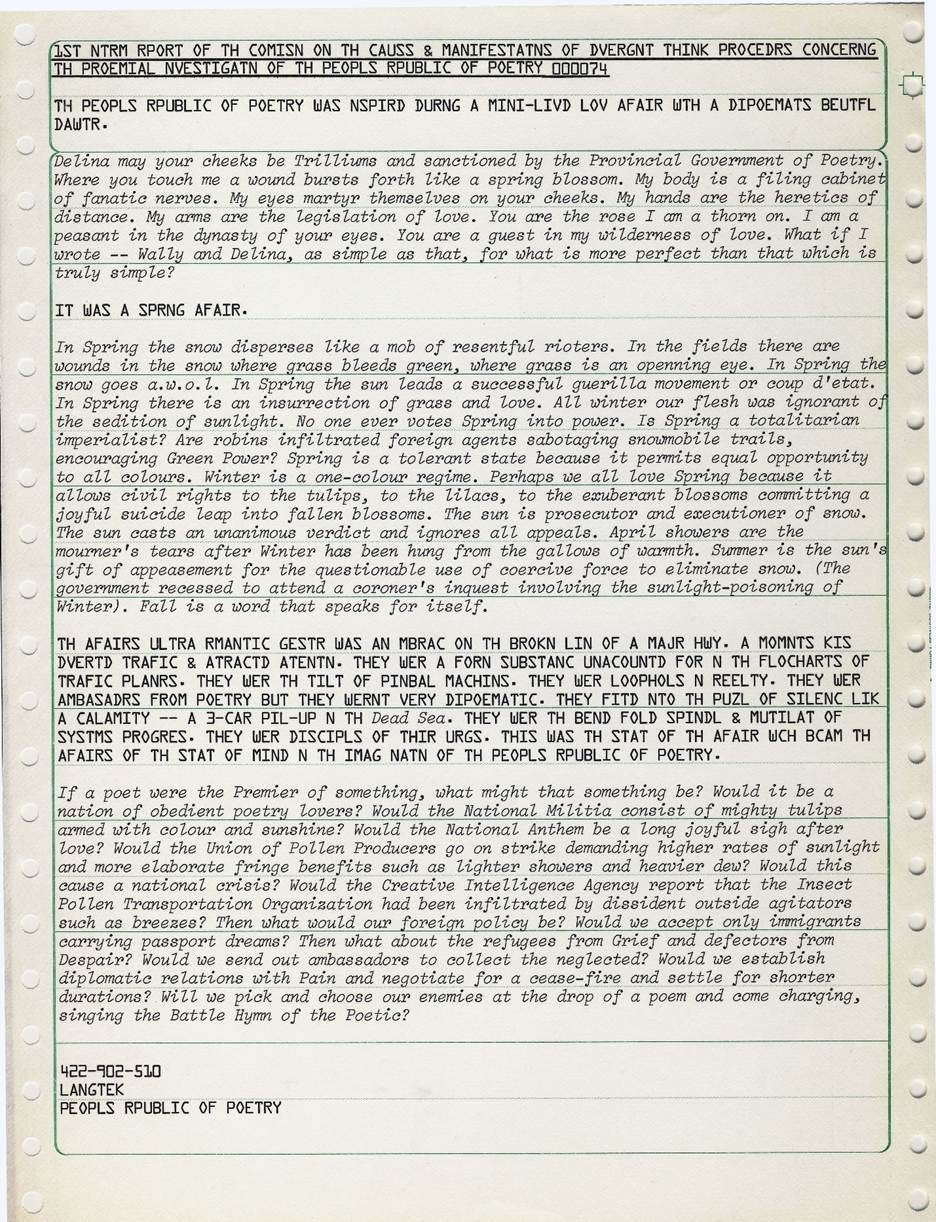
Texting was one aspect. The other was OCR (optical character recognition), machine readable. The PRP used IBM’s OCR FONT; THRUOUT TH 1970’S EVRYTHNG THT TH GLORIUS PEOPLS RPUBLIC OF POETRY PBLISHD WAS MOSTLY OCR TXTD. ITALICS WERE USD 4 THOS PORTNS OF TXT THAT CLD’T B OCR’D; place names, and quotes, anything personal or human.
NUSPEEK IS NOSPEEK
GOING 4WARD TH TXT WAS APLYD 2 COMPUTR PRNTOUT PAPR. THIS EMULATN WAS XCEDNGLY XACTNG. IT HAD 2B DUN ON AN IBM SELECTRIC WTH VARIUS FONT BALLS; OCR, Times New Roman italics. TH PAPR HAD 2B NSERTD N2 TH SELECTRIC PRFECTLY 2 ENABL TH TXT 2 MAINTAIN A PRFECT LEFTHAND MARGIN. THIS HAD 2B MAINTAIND EVEN IF TH TXT WAS 3 PAGS LONG. ALSO, NO WHITOUT OR ANY OTHR CORECTN WAS PERMITD, WHCH MAD TH PRODUCTN A 1-LETR-@-A-TYM, ERR-FREE, JUST LIK A REEL COMPUTR PRNTOUT.
NUTHINK IS NOTHINK
The notion was to make the poetic documents so immaculate and elegant that no one could know that they had been composed by hand, but truly believed it was computer-composed. When these documents were first published in various literary journals, the response was just what I wanted – belief that it was composed by a mainframe. The curator of the University of Manitoba Gallery was shocked to learn that each document had been done “by hand”.
Poetry and computers; what a blend. At the time, I was inquiring about ‘computer poetry’ and there was a bit of it around. It was awful; first because programmers are not poets but fancied themselves, second, because the programmers used randomizer algorithms for their compositions. They also included the basic rules of English; verbs, adverbs, nouns, adjectives, and all kinds of other grammatical rules. The results were yechspeek. There was no human intervention post-printout. The mistake by the programmers was the notion that algorithms can create comprehensive composition.
What the PRP had presented was impossible for computers to accomplish at the time. That was the mainframe 70s. Fast forward to the mid-nineties when the internet began to prevail, and personal computers began to develop the ability to present itself in the same manner as I had done during the 1970s.
That’s it for now. Stay tuned for the next missive which will explain the computational assembly of Shakespearean sonnets. In the meantime, below is one example of a ‘printout’ that displays the mix of OCR & italics. This document was also the first time there was any mention of the PRP. “What if a poet were the premier of something?” NJOY!