

Concrete poetry is a form of visual or language-based art, where the visual arrangement of words, letters, typography, spacing, and sometimes symbols on the page is as important as—or more important than—the conventional verbal or semantic meaning of the text. The layout often forms shapes, patterns, or structures that reinforce, illustrate, or even become the primary “meaning” of the poem. It draws inspiration from earlier avant-garde movements like Futurism, Dada, and calligrammes by Guillaume Apollinaire. peaked in popularity during the 1960s, and influenced later visual poetry, conceptual art, and digital/experimental literature.
Concrete. That’s conceptual concrete, so it was time to apply physical concrete to a poetic structure, a Shakespearean sonnet. It was August 31, 1974, the Creative Intelligence Anarchy, conceived of a world first and only, a 3D stand-alone sonnet in the backyard at (247) K9A 1L7.
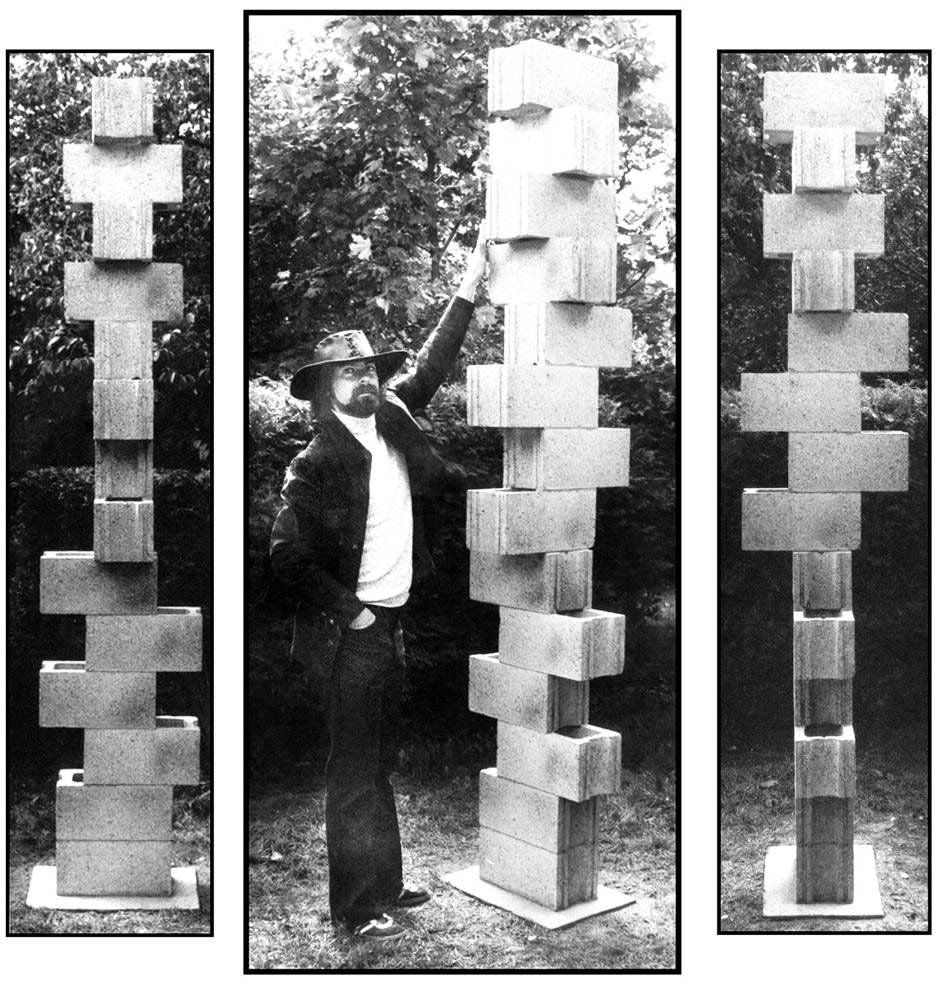
It was an eureka moment. “Let’s construct a concrete sonnet,” I said to the Minister of Texternal Affairs. So off we went to purchase 15 cinder blocks. The extra block was to fill the hole in the ground and to provide a level surface for the remaining 14 blocks.
Sonnets are composed from the top down, but in this case, it was formed from the bottom up – a case of re-verse for sure that led to a fortunate flaw that sub-versed the project. A minimal use of cement between the blocks held it together. It was a weekend project, not a permanent fixture. There was no rebar to hold it together. It was constructed for a photo op.
A Shakespearean Sonnet it is not. The rhyme schemantra became obvious once the photos were examined. It was from top to bottom ABABCDCDEFEFBB. That stands for booboo. Nevertheless, it was a prototype that led to other permutations of the glorious form.