The Creative Intelligence Anarchy of the glorious Imagine Nation of the Peoples Republic of Poetry thought it could be cool to code the backpoem structure of a Shakespearean sonnet. There are other sonnet schemes, but the CIA chose the Shakespearean because it was taught in English classes throughout the WordWideWorld. English is the lingua franca, and so is a Shakespearean sonnet. It’s the vanilla of sonnet forms.
The following rhyme scheme distinguishes it.
A
B
A
B
C
D
C
D
E
F
E
F
G
G
14 lines requiring 7 items to rhyme. Easy peasy. StatsCan provided the data. Gender genre seemed the simplest way to divide data; seven elements for males, seven for females. Suicide stats seemed a suitable subject to demonstrate the formula. The data was segmented into year groups, producing seven segments: years 1 to 14, 15 to 19, 20 to 24, 25 to 44, 45 to 64, 65 to over, and all ages combined for the rhyming couplet.
The formula and data were poured into a spreadsheet program. It was formatted into a vertical graph; viola, a statistical-based sonnet.
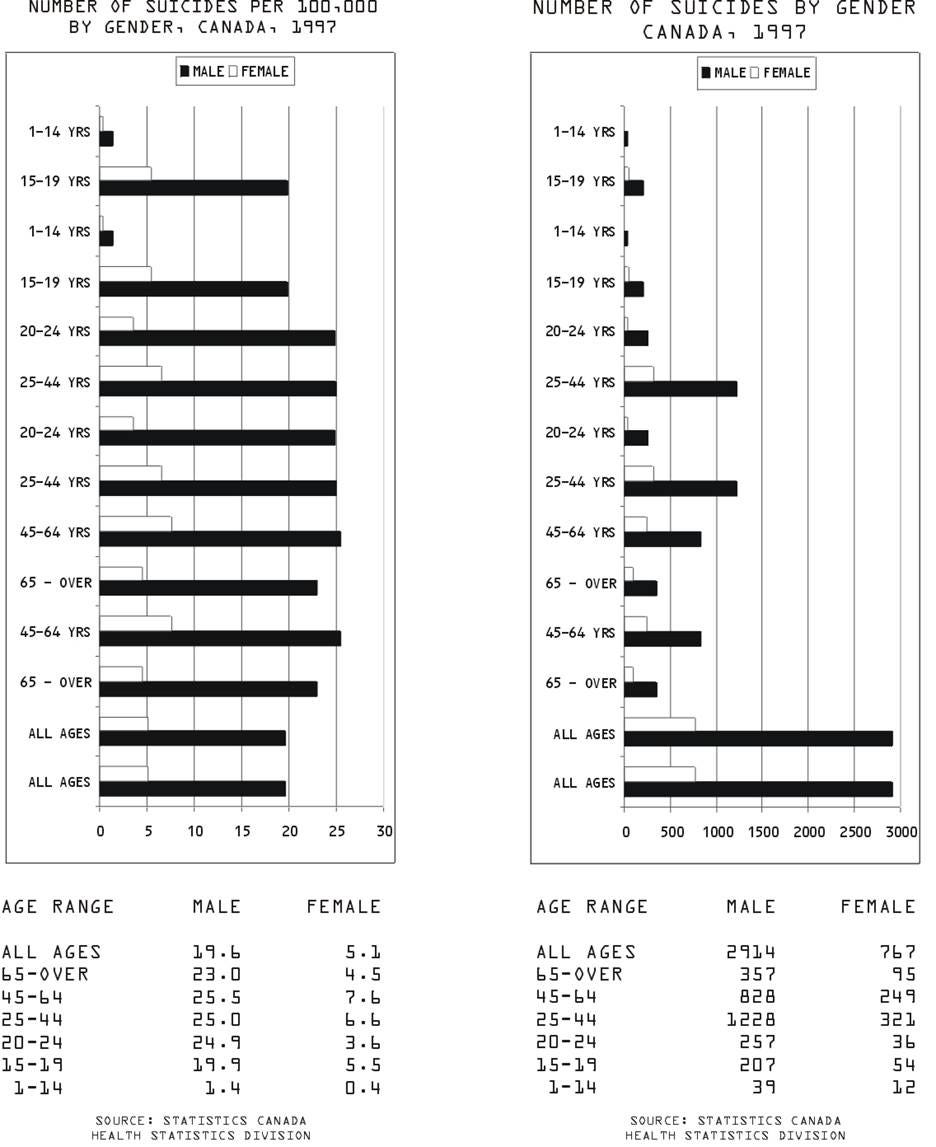
The sonnets were published in the University of Toronto Review.
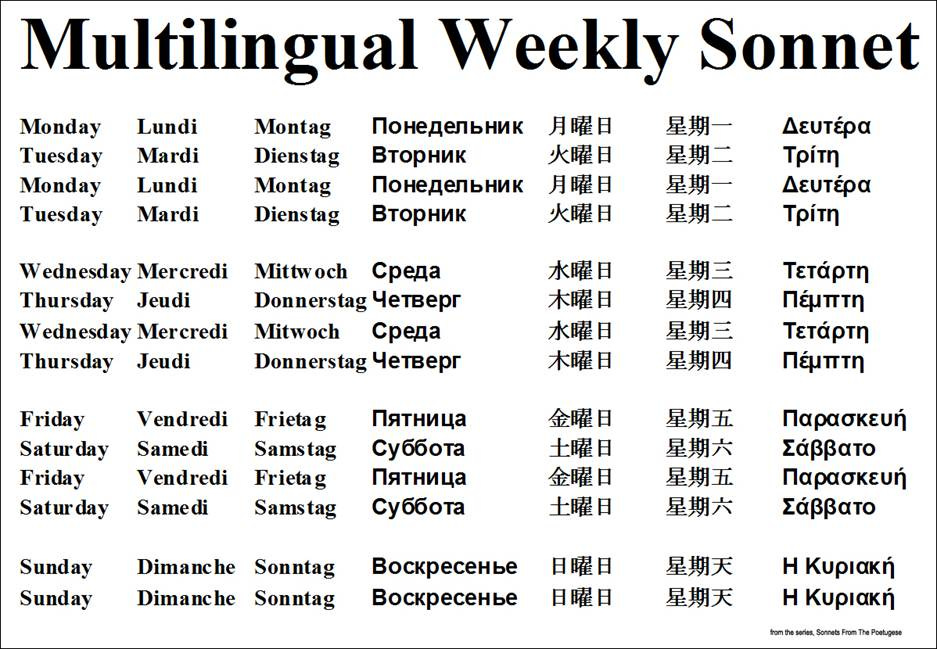
The CIA wanted more challenge, so it complicated things a bit more by leaving ascii-land. What else has seven components, especially in everyday life, everywhere? Days of the week, of course. Everywhere meant multiple languages, so seven major tongues were applied to the rhyme schemantra of a Shakespearean sonnet. Viola! A multilingual weekly sonnet.
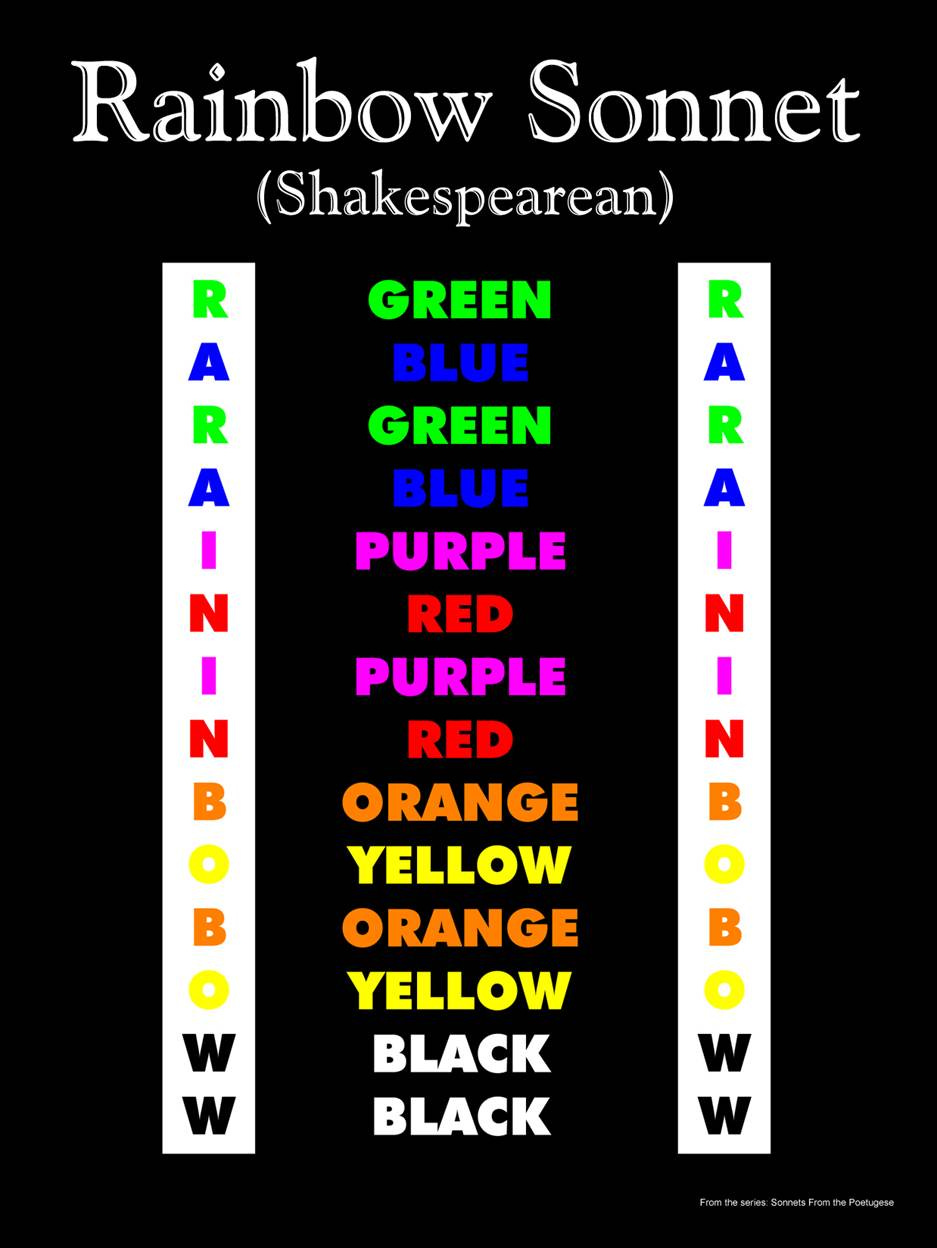
The CIA jacked up the complexity of this schemantra with colours, the visible spectrum of a rainbow. Notice that the word ‘RAINBOW’ has seven letters. Let’s represent the colours with the word for each colour. There are three primary colours (red, blue, yellow) and three secondary colours (orange, green, purple). Oh, oh, that leaves the sonnet one colour short of seven. Obviously, we’re not playing with a full deck yet.
Enter cleverness, a major manufracturing process of the CIA. What is white? The presence of all colours. What is black? The absence of all colours. Hmmmm. How to apply? There is a column of words; each word in the colour of its meaning, ending with the word WHITE. This will require black as the backdrop to make the white word visible. So far, so good. This column of words worked.
Clever demanded that the word, RAINBOW, also become a column, better yet, let this column bracket the central column. Maintain the colour schemantra until the last letter of the word, W, representing black. Hmmm, this will require the backdrop of these two columns to be white, which makes the black word visible. OK, let’s do it. Done.
This is a ++sonnet. Why? Because it displays the ‘volta’, the magic of a truly and fully workable sonnet. The volta (Italian for “turn”) in a Shakespearean sonnet is the pivotal, rhetorical or thematic shift—a change in thought, argument, tone, perspective, or emotional direction—that gives the poem its dramatic tension and resolution.
This happens when the rhyming couplet delivers a twist, summary, ironic comment, epigrammatic punch, or conclusive insight. It prevents the poem from being a simple description or complaint; instead, it introduces contrast, reversal, or revelation, making the sonnet dynamic and intellectually satisfying. Shakespeare’s Sonnet 130 is a prime example of how a volta works. So too, the Rainbow Sonnet.